Bridging the gap: The importance of finding common ground between religious groups and secular human rights organisations 

Oppressive governments depend, in part, on two things: unity among those who support them and divisions within the communities that do not. One of the greatest challenges in addressing freedom of religion or belief (FoRB) in countries where that right is regularly violated is bridging divisions between different groups within the religious sector, as well as the gap that often exists between the religious sector and secular human rights and other independent civil society organisations. 

Religious groups often occupy a unique position within larger independent civil society. They are networked and organised, to different extents, with members who regularly attend and participate in their activities. They often possess a dedicated physical space, where they are able to hold their activities with minimal outside interference. Some religious groups will run outward focused activities, providing social services. In many cases, religious leaders not only hold a significant decree of influence within their respective community – they may also be perceived as moral adjudicators more widely even by people who do not share their religious beliefs.  

Oppressive regimes are sensitive to the danger posed to them by a socially engaged religious sector and outspoken religious leaders who are willing to work hand in hand with larger civil society in defending civil and political rights. Division, therefore, is deliberately encouraged and stoked, often by intelligence and security agencies, with the goal of neutralising or coopting organised independent civil society, including the religious sector.  

Continue reading “Bridging the gap: The importance of finding common ground between religious groups and secular human rights organisations “

Pastor Rudy Palacios Vargas dared to speak out against injustice in Nicaragua. For that he has been labelled a murderer and a terrorist. 

On the evening of Thursday 17 July, armed police officers – some in uniform and others dressed in black or blue and with their faces covered – arrived in a coordinated operation at the homes of Pastor Rudy Palacios Vargas and several of his friends and family in Jinotepe Municipality, Carazo Department, Nicaragua. 

The police, who did not show any arrest warrants, broke down the doors of each house using their rifle butts and a tool called a ‘pig’s foot’ before proceeding to arrest Pastor Palacios Vargas, his sister Jéssica Palacios Vargas and brothers-in-law Pedro José López and Armando José Bermudez. Mauricio Alonso Petri, a political activist and friend of the pastor, and his adult son of the same name, who is a part of the worship team at Pastor Palacios Vargas’ church were detained as well. Family friend Olga María Lara Rojas, a former political councillor, who is a Protestant Christian but not a member of Pastor Palacios Vargas’ church, was also arrested at her home. 

The officers confiscated the detainees’ cell phones and other electrical devices and were reported to have taken them to the 3rd Police District, though the authorities initially refused to provide their family members with any information as to their whereabouts. 

Continue reading “Pastor Rudy Palacios Vargas dared to speak out against injustice in Nicaragua. For that he has been labelled a murderer and a terrorist. “

Where justice fails: How cultures of impunity lead to forced displacement in India and Mexico

On 11 June the families and loved ones of Neelkant and Pushpa Verma gathered for what should have been a day of celebration. The young Christian couple were due to marry in Raipur in India’s Chhattisgarh State, no doubt filled with excitement at what should have been one of the happiest days of their lives, and all the joy to follow in the years to come. 

But this excitement was cut short when three villagers in in their early twenties stormed the wedding venue, cutting off the electricity supply and declaring that Christians were not allowed to hold celebrations in the village. When Neelkant’s family attempted to contact the electricity board, over 30 villagers gathered outside of the venue, vandalising guests’ vehicles and setting the building on fire.  

The mob proceeded to hurl abuse at the women and tear some of their sarees. When the women’s children tried to defend their mothers, they were pelted with stones and forced to seek refuge in a nearby house. Once the victims were inside, they called the police who arrived quickly and escorted them to safety, managing to disperse the attackers.  

Continue reading “Where justice fails: How cultures of impunity lead to forced displacement in India and Mexico”

State repression knows no ideology

On 12 May a community in rural El Salvador gathered for a peaceful protest demanding their land rights. Within hours, the government responded with riot gear and arrests, striking fear among the families present. This is how authoritarian tendencies manifest themselves, no matter the political branding. 

In today’s polarised world, it is easy to label enemies by ideology. When we think of authoritarianism, our minds may leap to the right or the left. But beyond the party name or rhetoric lies something more universal: the impulse to silence those who question injustice. 

In recent weeks, two cases from opposite ends of the ideological spectrum have brought this to light. In one, a pastor in a country with a right-leaning government was arrested while seeking to protect his community from an unjust eviction. In the other, two pastors living under a left-leaning government were detained for speaking of God’s justice in defence of their son at a military tribunal. Though the contexts differ, the charges were similar: ‘public disorder’ and ‘resisting arrest’ in the former, and “‘disrespect’ and ‘disobedience’ in the latter. Neither government would tolerate independent voices raising moral concerns. 

Continue reading “State repression knows no ideology”

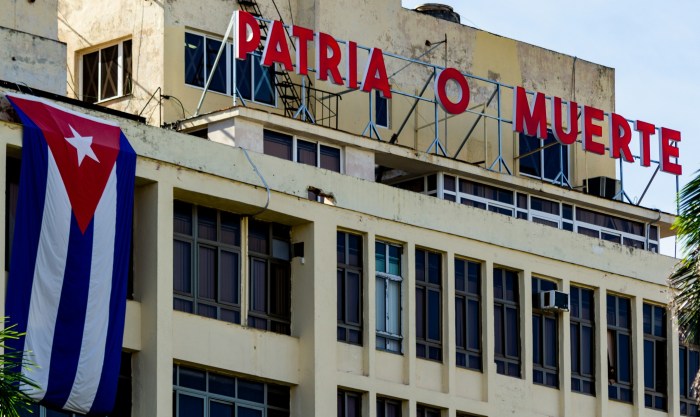
Prayer, outreach, free expression – the Cuban government won’t tolerate the truth

A mid-size church located in a population facing significant economic and social challenges organises a weeknight, evening prayer service. Members of the church attend and participate in a series of structured times of prayer. At times they pray silently, at others the pastor leads them in prayer, and in one session they gather around the national flag to pray for the needs facing those in their community and country. Their prayers speak of fundamental needs – for food, for medicine, for a reduction in crime, for the provision of basic services to all.  

In another part of the country, the pastor of a church takes steps to address a specific need in his community, which is also enduring hardship. Together with the church leadership, he coordinates a general collection to meet the needs. Members of the church, and many in the larger community, join in the effort and together they are able to put together packages of essential goods to give away to the most desperate.  

Neither of these scenarios would attract much notice in many parts of the world. Those who did not share the faith of those involved might think some of the practices a little strange, but not harmful. Not so in Cuba, however, where the simple act of praying for the country – especially in conjunction with the use of the national flag – and any effort by a religious group to meet the acute needs of the population, are met with hostility by the government, which is increasingly threatening religious leaders who organise such activities with criminal charges.

Continue reading “Prayer, outreach, free expression – the Cuban government won’t tolerate the truth”