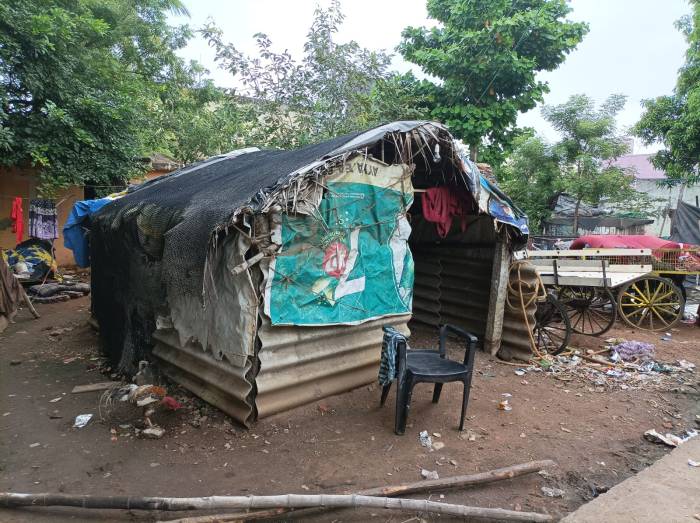
A hut in Mappedu, on the outskirts of Chennai, India.

The Narikuravar: A community in need of protection

In January 2023, CSW visited the Narikuravar community in Mappedu, on the outskirts of Chennai, and met with members of a community who for decades have suffered discrimination on the grounds of gender, and more recently on the grounds of religion as well. The following blog offers some reflections on the visit. Please note that the names have been changed for security reasons.

Radhika, a mother of three young girls, sat inside a little room with a thatched roof. With folded hands and a scarf over her head, she knelt down and prayed earnestly before turning to speak with me.  As a woman from a disregarded community who is also subject to restrictive gender-specific traditions, she would be excused for lamenting her circumstances but says that her new-found faith gives her the hope to live each day.

Radhika belongs to the Narikuravar community, a semi-nomadic tribe who were originally hunters and gatherers. She lives with around 30 other Narikuravar families in a tiny colony in Mappedu on the outskirts of Chennai. The Narikuravars have faced and continue to face discrimination in all spheres of life, including education, employment and even in securing accommodation.

Continue reading “The Narikuravar: A community in need of protection”
A protester holds a sign that reads 'Woman Life Freedom' during demonstrations following the following the death of Iranian woman Zhina ‘Mahsa’ Amini.

‘Woman, Life, Freedom’ – Iran faces a crisis with freedom of religion or belief and gender equality at its core

Iran is enduring its most turbulent period since the 2019-2020 pro-democracy protests, with gender equality and a lack of freedom of religion or belief at its very core. 

Since September 2022 distressing news reports have been emerging of violence meted out on Iranian citizens protesting for change – the arbitrary application of the death penalty, extrajudicial killings (including of minors),  maiming, excessive sentencing, and the suspicious deaths of several protestors after being released from detention, to highlight a few.

In the face of these violations an initially slow and largely reactive international response accelerated, and a special session of the UN Human Rights Council in November 2022 which established an independent, international fact-finding mission to investigate alleged human rights violations related to the protests, was followed by Iran’s expulsion from the UN Commission on the Status of Women in December 2022. Then in January 2023 the United States, the United Kingdom and the European Union announced sanctions on 10 additional Iranian individuals and one additional Iranian entity.

Continue reading “‘Woman, Life, Freedom’ – Iran faces a crisis with freedom of religion or belief and gender equality at its core”

Tú eres mi otro yo: La importancia de educar a las mujeres mexicanas del futuro

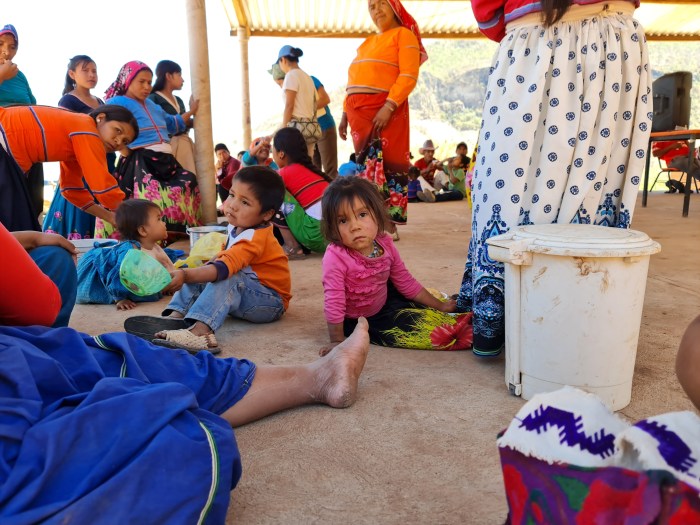
Florinda tenía apenas 11 años cuando su familia fue desplazada de la comunidad de San José Yashtinín, Municipio de San Cristóbal de las Casas, en el estado de Chiapas, México en 2012. No pudo continuar con sus estudios durante dos años después del desplazamiento de su familia porque el papeleo y los certificados que necesitaba para inscribirse en una nueva escuela se quedaron en el lugar del que tuvo que huir. En 2019 en una entrevista con CSW mencionó que esperaba terminar sus estudios para enseñar a otros niños. 

Otra mujer, Alma, tenía 17 años cuando su educación fue interrumpida después de que su familia fuera desplazada por la fuerza de su comunidad en Tuxpan de Bolaños, Municipio de Bolaños, en el Estado de Jalisco, en diciembre de 2017. Posteriormente no pudo inscribirse en una nueva escuela, por lo que tuvo que renunciar a sus planes de convertirse en enfermera. 

Hace tres años, para conmemorar el Día del Niño en México, Alma viajó a la Ciudad de México para reunirse con funcionarios del gobierno. También se reunió con el Consejo Nacional para Prevenir la Discriminación (CONAPRED) quien lamentó lo sucedido: “Les debemos una disculpa, este país les debe una disculpa… Ciertamente hemos fallado en el proceso, pero estamos aquí para protegerte, para que tu trayectoria en la vida sea lo que tú has deseado que sea“.

Continue reading “Tú eres mi otro yo: La importancia de educar a las mujeres mexicanas del futuro”

You are my other me: The importance of educating the Mexican women of the future 

Florinda was just 11 years old when her family was displaced from the community of San José Yashtinín, San Cristóbal de las Casas Municipality, in Mexico’s Chiapas State in 2012. She was unable to continue with her studies for around two years following her family’s displacement because the paperwork and certificates she needed to enrol in a new school were left behind. In 2019 she told CSW she hoped to finish her studies in order to teach other children. 

Another woman, Alma, was 17 years old when her education was interrupted after her family was forcibly displaced from their village of Tuxpan de Bolaños, Bolaños Municipality, Jalisco State, in December 2017. She was subsequently unable to enrol in a new school, derailing her plans to become a nurse. 

Three years ago, to mark Children’s Day in the country, Alma travelled to Mexico City to meet with government officials. She also met with the National Council to Prevent Discrimination (CONAPRED) who expressed regret for what had happened: “We owe you an apology, this country owes you an apology…We have certainly failed in the process but we are here to protect you, so that your trajectory in life is what you want it to be.” 

This year, as Mexico observes Children’s Day, we call for more than an apology; we call for action.  

Continue reading “You are my other me: The importance of educating the Mexican women of the future “
Sudan City View

Beyond the headlines: Freedom of religion or belief and women’s rights in Sudan

The political shifts in Sudan from the authoritarian rule of Omar al Bashir to the transitional government (a mix of civilians and the military), has garnered many positive headlines. The welcome changes and relief that there is a reservoir of political will to address the root causes of the country’s conflicts have indeed been positive.

In particular, the pledges of reform, the recent announcement that the government will accede to the Convention for the Elimination of Discrimination Against Women (CEDAW), the changing of some public order laws that infringed on the rights of women, especially women from marginalized communities, as well as the removal of apostasy have been warmly received.

However, beneath the headlines are simmering social hostilities which have already generated a series of violations that have not been sufficiently investigated or addressed. These violations threaten to undermine the positive steps taken so far, and both the transitional government and supporters of this new political arrangement in the international community need to note and address them.

Continue reading “Beyond the headlines: Freedom of religion or belief and women’s rights in Sudan”