Remembering Kandhamal: a legacy of institutional failure

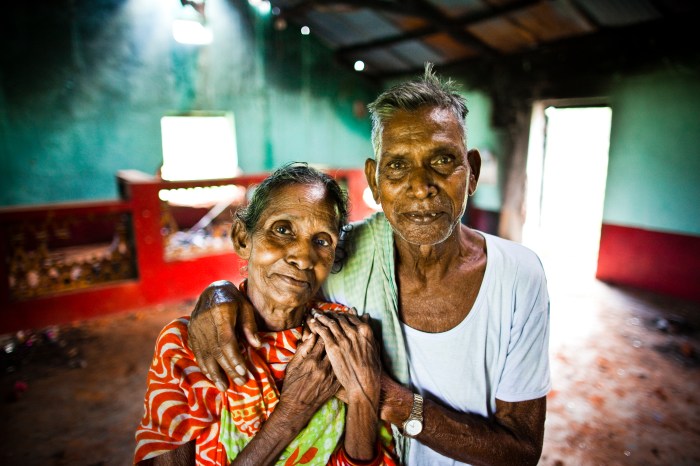
Featured image: Minasi (75) and his wife Sartabati (68) have seen their church in Mukundipur village attacked on five occasions, in 1966, 1975, 1998, 2007 and 2008. They said they did not think they could cope with another attack. Gajapati District, Orissa. Marcus Perkins/CSW 2009.

25 August 2016 is the eighth anniversary of India’s worst instance of communal violence against Christians. Many of the victim-survivors in Kandhamal, Odisha State, continue to wait for justice.

It is estimated that over 90 people were killed, 600 villages ransacked and 5,600 houses looted and burned in the 2008 attack. Approximately 54,000 people were left homeless, while 295 churches and places of worship were destroyed. Furthermore, an estimated 13 schools, colleges and philanthropic institutions for the sick were looted and burned. Approximately 2,000 Christians were forced to renounce their faith during the violence and 10,000 children were robbed of their education.

At every stage, the response of government, law enforcement and the criminal justice system to this tragedy has been woefully inadequate, undermining justice for the victim-survivors.
Continue reading “Remembering Kandhamal: a legacy of institutional failure”

The Lawyers That Were Left

It has been a year since over 300 human rights lawyers, activists, as well as those connected to them (including their friends and family), were detained by the Chinese government. That’s equivalent to one person harassed or disappeared every day since last July. Some of these lawyers have since vanished into China’s prison system. Others were released, but have lived with the threat of re-arrest hanging over them ever since.

Continue reading “The Lawyers That Were Left”

Interview with a Sri Lankan Human Rights Advocate – Part 1

Patterns of discrimination against religious minorities

CSW spoke to a human rights advocate in Sri Lanka whose identity for security reasons has been withheld. This post has been edited for clarity.

Q: Could you comment on religious extremism in Sri Lanka?

A: A recent surge of religious extremism in Sri Lanka began sometime in 2012 during the tenure of the previous government, with the emergence of extremist groups such as Bodu Bala Sena (Buddhist Force Army), or the Sinhala Ravaya, or Hela Bodu Pawura. These groups emerged after the ethnic war, which ended in May 2009. These extremist groups led violent attacks against religious minorities. Most violent attacks were led with impunity and tacit approval. The judiciary was also very much biased.

For example, there was one particular case that was filed against the General Secretary of the Bodu Bala Sena. There was video-document evidence submitted in the High Court of Colombo in that particular case. Even after video evidence was submitted, the General Secretary was released, and the case came to a settlement. The video evidence was not taken into consideration by the court – and this is the High Court of Colombo. That was [how] the situation used to be in Sri Lanka. These Buddhist extremist groups also led a lot of hate campaigns, against Muslim minorities as well. They also used the media as a tool to lead these hate campaigns. And even when they led violent attacks, they also used media to portrayed a biased attitude of the minority victim who actually got attacked rather than the perpetrators themselves.

Continue reading “Interview with a Sri Lankan Human Rights Advocate – Part 1”

Interview with a Sri Lankan Human Rights Advocate – Part 2

Part 2: Circular 2008

CSW spoke to a human rights advocate in Sri Lanka whose identity for security reasons has been withheld. This post has been edited for clarity.

Q: Would you be able to share with us what groups like yours – and other civil society organisations based in Sri Lanka – are doing at the moment to address freedom of religion or belief (FoRB) violations?

A: There are various strategies. One of the core things that we do is to document incidents. We do a lot of advocacy at a local level by meeting government officials and ministers. We also lobby with some of our international partners as well. We file cases on behalf of victims who are religious minorities, and we take up different legal interventions. For example, when there is an attack, we will not file a case immediately but we try first to send out legal letters; working with the national police commission, working with the relevant ministries, and so on. If that does not work out, then of course we will file a case against the authorities in the Supreme Court.

In most instances, we support cases that have been filed against Christians. We also do a lot of other projects where we work on broader human rights issues and we form local networks with community leaders, with pastors. We have consultation processes with them, we train them, we have advocacy seminars – making them aware of their legal rights and teaching them good practices. We also work with the media and journalists, bringing together journalists and the media on good reporting for religious violence.

Q: What can international organisations do to echo the concerns you’ve identified?

Continue reading “Interview with a Sri Lankan Human Rights Advocate – Part 2”

On the Road with Cardinal Bo, a Personal Reflection

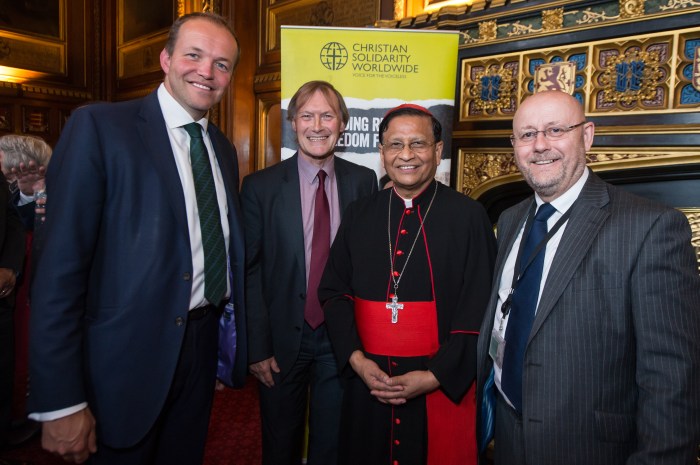
Featured image left to right: David Burrowes MP, Sir David Amess MP, Cardinal Bo, and CSW’s Chief Executive Mervyn Thomas. Photo Credit: mazur/catholicnews.org.uk

In the Chapel of St Mary Undercroft, the parliamentary chapel just underneath Westminster Hall in the Houses of Parliament, Burma’s first-ever Cardinal celebrated Mass.

“Coming from a country, Burma, that is just emerging from over half a century of cruel, brutal military dictatorship, a country torn apart by war, ravaged by religious and ethnic persecution, with rampant corruption and dire poverty, into a new Easter dawn of democracy, to stand here in this chapel with all that it symbolises and represents is an immense joy,” Cardinal Charles Bo said. “Britain and the British Parliament has a long history with Burma; many of you have been with us in our darkest hour, stretching out a hand of friendship and solidarity in our time of need, raising a voice for us when we were voiceless.”

It was just one of many beautiful and significant moments during Cardinal Bo’s almost three-week tour of the United Kingdom and Brussels, which began with Mass in St Andrew’s Cathedral, Glasgow, with a piper on the door. The tour then took us the length and breadth of the UK, and to Westminster and the European Union.

Continue reading “On the Road with Cardinal Bo, a Personal Reflection”