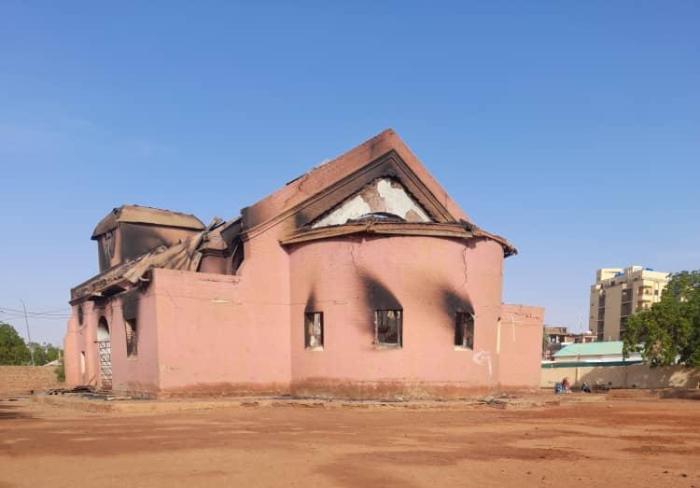
The Episcopal/Evangelical Church in Omdurman, which was shelled on 1 November 2023.

Sudan must not be allowed to slip off the international agenda

‘The land is valuable, and it will be easier to seize it if the buildings have been destroyed by war.’

This was the reaction of a CSW source to the bombing of churches and properties in Omdurman and Khartoum El-Shajara in Sudan at the start of the month.

On 1 November the Sudanese Armed Forces (SAF) shelled and completely destroyed a church that was used by the Episcopal and Evangelical denominations in Omdurman. It was the largest and second oldest church in the area, and its destruction came just three weeks after the Evangelical Commercial School and the Evangelical Secondary School were also bombed.

Continue reading “Sudan must not be allowed to slip off the international agenda”
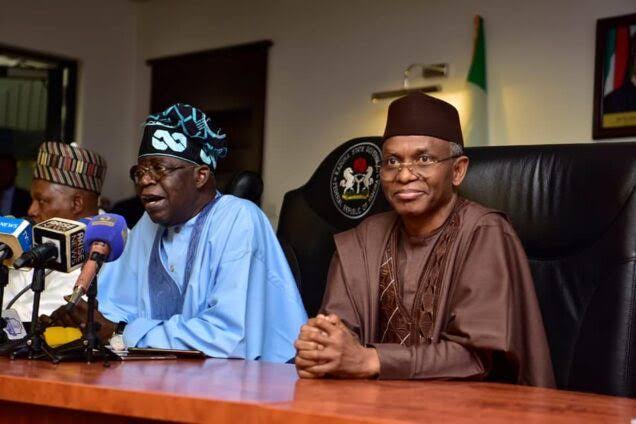
Former governor of Kaduna State Nasir El-Rufai with current Nigerian president Bola Ahmed Adekunle Tinubu.

We must not let Nigeria slide any further into failed statehood

‘Of course, we do consider religion, but I would not tell them that…’. It seems that Nasir El-Rufai, governor of Nigeria’s Kaduna State from May 2015 until May 2023, is no longer hiding his biases.

Addressing a group of Muslim clerics on his penultimate day in office after his party, the All Progressives Congress (APC), was declared the winner of the Kaduna State gubernatorial election, El-Rufai spoke extensively about how the APC had capitalised on religion, including by running on a Muslim-Muslim ticket, to secure electoral victory.

‘What we are able to achieve in Kaduna, we’ve now achieved on the national level,’ he added – a reference to the controversial and disputed victory of the APC in the presidential elections in February this year, also via a Muslim-Muslim ticket.

Continue reading “We must not let Nigeria slide any further into failed statehood”
Leaders from the Eritrean Orthodox Tewahedo Church at Timkat Festival in Asmara, Eritrea.

The international community must assist in transforming Eritrea’s pathocracy into a genuine democracy

27 April 1993: Eritrea declares official independence from Ethiopia after a referendum which saw a 98.5% turnout with a 99.83% vote in favour.

The vote took place nearly two years after the defeat of Ethiopian forces in Eritrea in May 1991, which brought with it an end to nearly three decades of civil war. The referendum installed the leader of the Eritrean People’s Liberation Front (EPLF, which later became PFDJ – People’s Front for Democracy and Justice) Isaias Afewerki as president, and it was hoped that he would lead the Eritrean people into a just and democratic future – then-US President Bill Clinton even referred to him as a ‘renaissance African leader’.

Sadly, this did not occur. Afewerki remains the only ruler Eritrea has ever known, and under his leadership the nation’s heroic liberation struggle has been resolutely betrayed due to his obsession with absolute power.

Continue reading “The international community must assist in transforming Eritrea’s pathocracy into a genuine democracy”
Man in black and white long sleeve shirt holding red stick in Sudan.

As Sudan forms a new transitional government, the international community must not repeat its mistakes

April has become a significant month for the nation of Sudan. This year, after more than 18 months under the leadership of a military junta that seized power in October 2021, the month will hopefully see the formation of a new transitional government, and the possible dawn of a new chapter for the country.

But we have been here before. On 11 April 2019, after months of unprecedented nationwide protests, Sudan’s president of nearly 30 years, Omar al Bashir, was ousted.

It was hoped that his removal would bring an end to three decades of oppressive rule characterised by widespread violations of human rights, including of the right to freedom of religion or belief (FoRB) – and to some extent it did.

Continue reading “As Sudan forms a new transitional government, the international community must not repeat its mistakes”
School children in the Central African Republic.

Ten years on from coup in the Central African Republic; armed alliances shift but civilians continue suffering

On 23 March 2013 the world awoke to the news that President François Bozizé of the Central African Republic (CAR) had fled the country and a rebel coalition had taken the capital. The somewhat automatic response from the African Union (AU) condemning the unconstitutional handover of power was matched by ensuing chaos in the country as a loose coalition of rebel groups, predominantly from the north of the country and broadly Muslim, battled over who would become president. Eventually it was Michael Dijotida who took the helm and oversaw the country for nine months.

It was during that first nine months that some of the most serious human rights abuses were perpetrated, while global leaders pondered their response. As the rebel coalition, known as the Seleka, advanced on the capital, they left death and destruction in their wake. Meanwhile, religious leaders of all faiths would travel to communities, where at times bodies still lay on the ground, to comfort mourners and urge them not to take revenge.

The AU largely led the global response, with the exception of France, which decided to put troops on the ground while the UN negotiated the creation of a peacekeeping mission.

Continue reading “Ten years on from coup in the Central African Republic; armed alliances shift but civilians continue suffering”