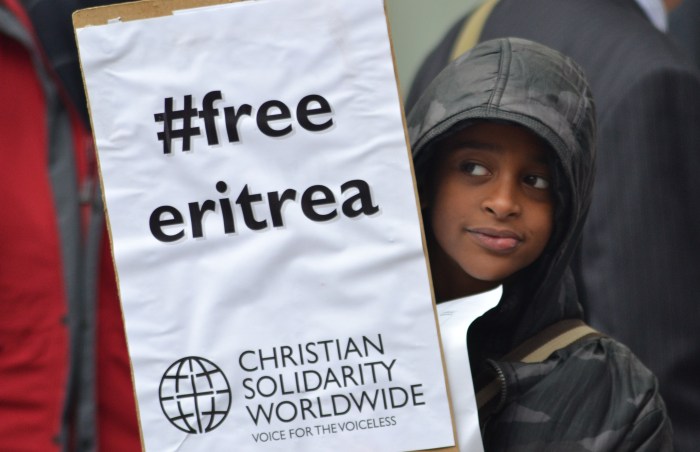
Thousands of Eritreans of all faiths and none are detained without charge or trial in Eritrea. Join us as we protest for change.

Germano Nati Gojo, an Eritrean politician, was arrested at his home by security agents as he listened to the radio on his veranda. One agent stood outside the gate. The other entered and said: “Sir, we need you on a work-related issue”. Saying nothing, Germano Nati Gojo stood up, went to change his clothes and left with them. His two younger children, then aged 16 and 12, witnessed this. The family has not seen or heard from him in 17 years, despite inquiring.

His eldest son, Yona Germano Nati, addressed the UN Human Rights Council in Geneva in March 2018.  He spoke of how his father had joined the struggle for independence of Eritrea in 1976, shared the story of his father’s enforced disappearance in September 2001, and described their poignant last meeting prior to the arrest, during which his father expressed his readiness to be jailed alongside his pro-reform colleagues who are now known collectively as the G 15.

Continue reading “Thousands of Eritreans of all faiths and none are detained without charge or trial in Eritrea. Join us as we protest for change.”
The UN Belongs to All of Us: Chinese Prisoners of Conscience Speak Out

Welcome to the United Nations. It’s your world.

Until recently, when you accessed the United Nations (UN) website, these words would appear. They’re still used on some webpages, and the sentiment behind them still stands.

The UN is often the subject of criticism, and its flaws are well-documented, yet it remains one of the most important arenas for raising human rights concerns, including the right to freedom of religion or belief.

Three times a year, in Geneva, Switzerland, the UN Human Rights Council comes together and UN staff, member state delegations and non-governmental Organisations (NGOs) all rub shoulders in meetings, formal sessions and – frequently – impromptu chats over coffee and in canteen queues.

On the agenda are some of the most serious human rights situations in the world.

This is also an opportunity for NGOs like Christian Solidarity Worldwide (CSW) to organise side events running parallel to discussions at the Council, where victims of human rights violations, as well as experts and activists, can present their cases in an open forum. In March 2018, CSW hosted one of its first side events at the UN Human Rights Council since obtaining ECOSOC Consultative Status: an opportunity to discuss some of the most severe and complex challenges to religious communities in China.

Continue reading “The UN Belongs to All of Us: Chinese Prisoners of Conscience Speak Out”

FoRB in China: The UK needs to speak out


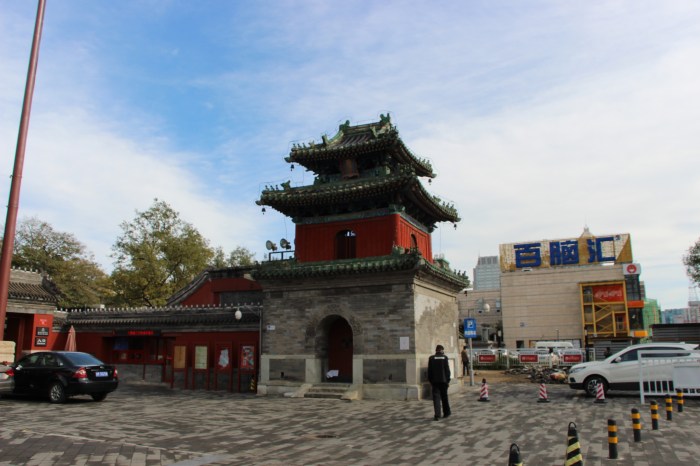
Prime Minister Theresa May’s first official visit to China, which begins today, is billed as an opportunity to boost trade with an important ally. But it will also take place against the backdrop of the country’s violations of fundamental human rights, including freedom of religion or belief.

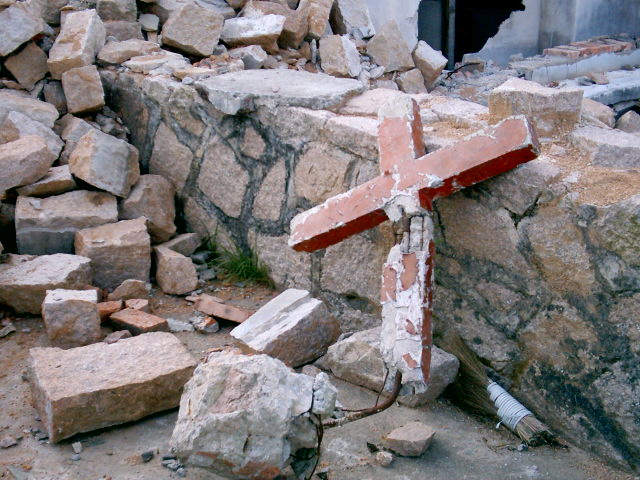
In the last month, Christians have been detained, and unregistered churches shut down or destroyed ahead of the implementation of revised Regulations on Religious Affairs, which strengthen state control over religious activities in China.

Unregistered churches, sometimes called house churches, are independent churches which have not registered with the state-sanctioned Three Self Patriotic Movement. The new regulations are due to come into force tomorrow, giving Mrs May a rare opportunity to speak directly to the Chinese government and publicly to reiterate the UK’s commitment to defending human rights.

Continue reading “FoRB in China: The UK needs to speak out”

Guilty by Association: Increased Targeting of Family Members in Cuba

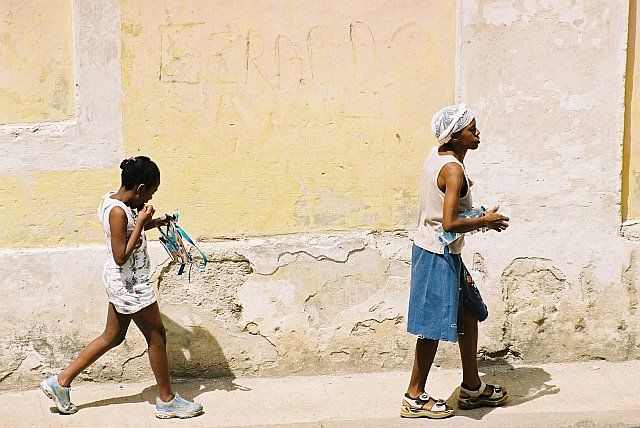
The Cuban government has a long-standing policy of targeting the children and other family members of church leaders and activists who it deems to be a problem; one of many tactics designed to ratchet up the pressure on them.

Religious leaders are increasingly standing up to government pressure and becoming bold in their efforts to defend religious freedom in the country, as the Cuban government’s Office for Religious Affairs (ORA) cracks down on unregistered religious groups and other groups that it perceives to be unsupportive of the government.

CSW’s latest report on freedom of religion or belief (FoRB) in Cuba reveals that the death of Fidel Castro in November 2016 failed to mark any significant improvements to FoRB in Cuba; instead, the arbitrary detention, harassment, restriction and surveillance of religious leaders and adherents has continued throughout the first half of 2017, as has the confiscation of church properties. In addition, several cases of family members of church leaders and activists singled out for harassment and discrimination have been brought to CSW’s attention in recent months.

Continue reading “Guilty by Association: Increased Targeting of Family Members in Cuba”

No Ifs, No Buts: Torture Should Be Universally Condemned

“He was forced to take medicine. They stuffed the pills into his mouth… After taking the pills he felt pain in his muscles and his vision was blurred… He was beaten. He endured gruelling questioning while being denied sleep for days on end…” 

Wang Qiaoling describing the torture of her husband, lawyer Li Heping

“Even our breaths were suppressed. No voices. No texts. No images. No talking. No walking. Our hands, feet, our posture…every body movement was strictly limited. We needed permission for even the most trivial action”.

 Lawyer Zhao Wei, the youngest legal assistant detained in the 709 Crackdown

“Prisoners were also put in cages submerged mostly in water, and left inside for seven days, the entire body underwater with a space to breath at the top. As they stood in the water and tried to sleep, rats would scurry about outside the cage, biting their nose and ears.” 

Letter to world leaders by ‘709’ Family Members

These are just a few accounts of the torture experienced by human rights lawyers in China. Over 300 lawyers, activists, colleagues and family members were detained, interrogated or disappeared in a sweeping crackdown beginning on 9 July 2015, dubbed the 709 Crackdown. Two years on, most have been released, some on “bail” conditions amounting to house arrest, but with news of their release have come numerous testimonies of physical and psychological torture including frequent beatings, sleep deprivation, forced medication, violent threats, and prolonged isolation.

Use of torture in China

Lawyers and activists are by no means the only victims of torture. Many of the lawyers caught up in the crackdown had defended clients who had been tortured by police or security agents, including those arrested in connection with their religion or belief such as Falun Gong practitioners and Christians associated with unregistered churches, as well as those accused of crimes not related to politics or religion.

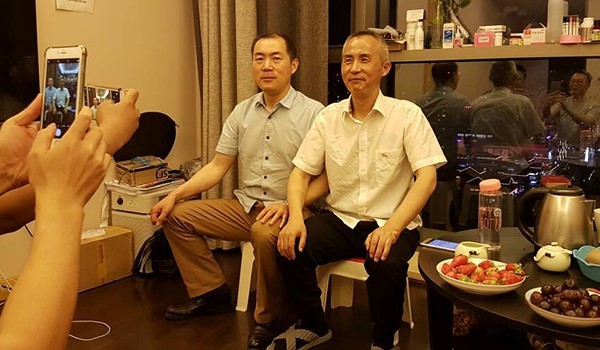
Li Heping reunion
Human rights lawyer, Li Heping (right) pictured with his brother Li Chunfu (left) following his release from detention.
Continue reading “No Ifs, No Buts: Torture Should Be Universally Condemned”