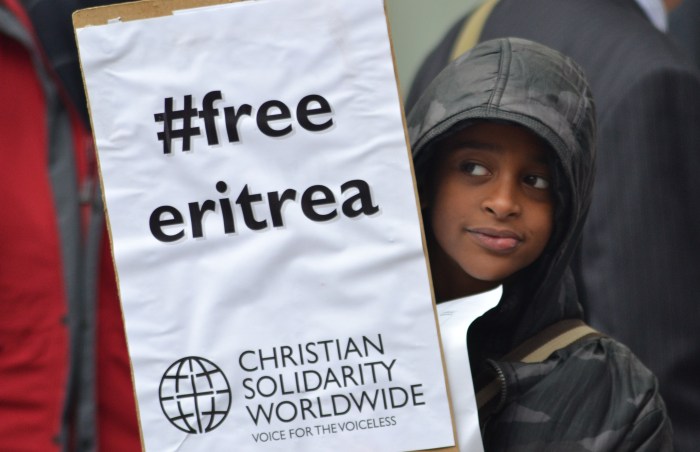
Thousands of Eritreans of all faiths and none are detained without charge or trial in Eritrea. Join us as we protest for change.

Germano Nati Gojo, an Eritrean politician, was arrested at his home by security agents as he listened to the radio on his veranda. One agent stood outside the gate. The other entered and said: “Sir, we need you on a work-related issue”. Saying nothing, Germano Nati Gojo stood up, went to change his clothes and left with them. His two younger children, then aged 16 and 12, witnessed this. The family has not seen or heard from him in 17 years, despite inquiring.

His eldest son, Yona Germano Nati, addressed the UN Human Rights Council in Geneva in March 2018.  He spoke of how his father had joined the struggle for independence of Eritrea in 1976, shared the story of his father’s enforced disappearance in September 2001, and described their poignant last meeting prior to the arrest, during which his father expressed his readiness to be jailed alongside his pro-reform colleagues who are now known collectively as the G 15.

Continue reading “Thousands of Eritreans of all faiths and none are detained without charge or trial in Eritrea. Join us as we protest for change.”

#FREELEAH

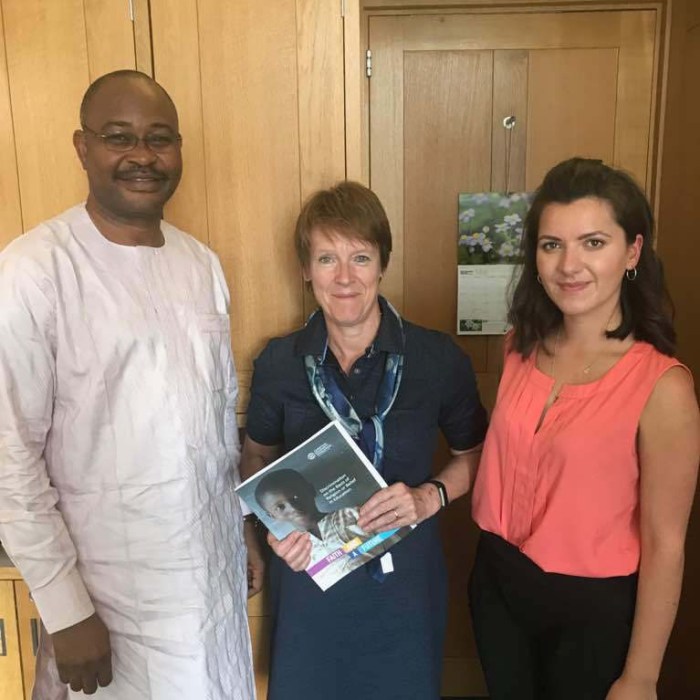
A guest blog by the Rt Hon Dame Caroline Spelman MP. 

The Rt Hon Dame Caroline Spelman MP is Conservative Member of Parliament for Meriden and Second Church Estates Commissioner. In May 2018 she met with Rev Yunusa Nmadu, CEO of CSW Nigeria and CSW UK’s Parliamentary Officer, Alice Braybrook to discuss freedom of religion or belief in Nigeria.

Today is the 15th birthday of Leah Sharibu. But, unlike most young girls around the world, she will be spending her birthday in captivity.

On 19 February 2018, Leah was among 110 girls who were abducted from the Government Girls Science and Technical College in Dapchi, north eastern Nigeria, by the al-Barnawi faction of Boko Haram. The oldest abductees were 18 years of age; the youngest were 11.

On 21 March 2018, over a month after their capture, Boko Haram returned 105 of the girls to Dapchi, following negotiations with the government. Five had reportedly died during the arduous journey to Boko Haram’s hideout.

However, returnees confirmed that Leah Sharibu, the sole Christian among them, remained in captivity due to her refusal to convert and wear a hijab. Her friends said they begged her to feign conversion so they could all leave together.  However, a tearful Leah is reported to have informed them she could not live with herself if she did so. She also asked them to tell her mother, Rebecca Sharibu, to pray for the will of God to be done in her life. In a comment to Nigerian media her father Nathan Sharibu said: “They gave her the option of converting in order to be released but she said she will never become a Muslim. I am very sad… but I’m also jubilating too because my daughter did not denounce Christ.” 

Continue reading “#FREELEAH”

Impunity Breeds Distrust – Religious Leaders as Human Rights Defenders in Mexico

Who do you trust to look after your community? According to the 2018 Edelman Trust Barometer survey, 71% of Mexican citizens would rather put their trust in non-governmental organisations (NGOs) than the government, which has the confidence of a mere 24% of the population.

These stark statistics beg the question: what could be driving such levels of distrust in the Mexican government?

Currently, Mexico is the second most dangerous country in the world to be a Catholic priest. Other religious leaders are also increasingly targeted; between November 2013 and April 2018, 30 religious leaders were killed. In April 2018 alone, three religious leaders were killed. Moreover, Mexico is the second most dangerous country in the world to be a journalist.

Religious leaders often take on the role of human rights defenders (HRDs), engaging with various human rights initiatives in order to bring the issues of their respective communities to the attention of those who can provide legal, practical or advocacy assistance. As such, these religious leaders often fulfil the role of community leaders as well as HRDs. It’s dangerous work. In 2017, 32 HRDs were killed according to a report by Front Line Defenders.

Continue reading “Impunity Breeds Distrust – Religious Leaders as Human Rights Defenders in Mexico”

Warning Signs Unheeded: The Kandhamal Tragedy

Kandhamal district is among the poorest and most marginalised in Odisha (formerly Orissa) state, India. On 25 August 2008, it was the epi-centre of communal attacks against the Christian community in India. Local monitoring groups have estimated that over 90 people were killed with at least 54,000 displaced and over 300 churches destroyed by groups belonging to the Rashtriya Swayamsevak Sangh (RSS) that espouses the Hindutva ideology.

Ten years on, attacks on religious minorities and on freedom of expression by groups belonging to the RSS continue. The lack of official condemnation towards acts of intimidation and violence has further empowered these groups. As with recent attacks against religious minorities in India, the carnage that unfolded in Kandhamal was not a one-off isolated incident devoid of a historical narrative.

Continue reading “Warning Signs Unheeded: The Kandhamal Tragedy”

As a newly elected member of the Human Rights Council, Nepal must practice what it pledges

All elected Member States of the United Nations Human Rights Council (HRC) have a special obligation to protect and promote human rights. While every State has a responsibility to uphold human rights, in theory and in practice, Member States on the Council are in a unique position; and to that end, it is important that they practice what they’re supposed to preach.

During the HRC elections, candidates submit voluntary pledges, committing to the promotion and protection of human rights, and once elected, to maintaining high standards towards the protection and promotion of human rights.

Often, a State’s campaign for election is not free from criticism. Indeed, current HRC Council Members include Saudi Arabia, Pakistan, and China; countries which are frequently pulled up for serious human rights violations.

“While every state has a responsibility to uphold human rights, in theory and in practice, Member States on the Council are in a unique position; and to that end, it is important that they practice what they’re supposed to preach.”

In 2017, Nepal was elected as a Member of the HRC. The country will serve for a period of three years, and could serve up to two consecutive terms. It is important that Nepal embraces its position on the Council, calls out human rights abuses, makes recommendations, and promotes peace and reconciliation and supports the work of Special Procedures among other human rights mechanisms.

Continue reading “As a newly elected member of the Human Rights Council, Nepal must practice what it pledges”