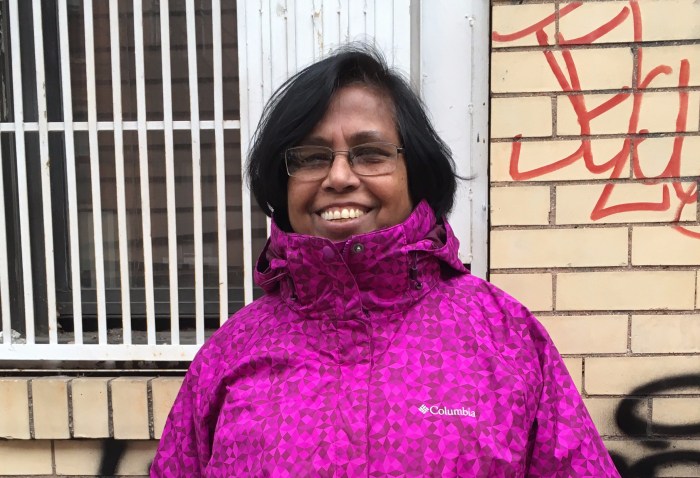
Rosie Costa

Rosaline (Rosie) Costa, a Bangladeshi human rights activist, was forced to leave the country in July 2016. In 2017, CSW interviewed her in New York. During the interview, Rosie discussed the reasons she had to leave Bangladesh, and shed light on issues of religious freedom in the country.

Rosie’s involvement in human rights work began in 1986, after she left the community of nuns to which she belonged for 17 years to pursue human rights work. She spent time working with women and children in the garment industry, establishing a hostel for rescued children who had been forced into madrasas (colleges for Islamic instruction), and speaking around the world about issues faced by minorities and particularly Hindus.

Forced To Flee

While Rosie had been no stranger to risk in her work, her fears for her safety grew following a number of killings of Christians in Bangladesh, perpetrated by people claiming to belong to Daesh. “I realised that I was being followed by some people, that’s when I left the country … I saw how the people were killed, so if something was to happen to me nobody would be able to rescue me from these people.”

Continue reading “Rosie Costa”

The European Parliament’s Watchdog on Freedom of Religion or Belief: Bark or Bite?

European Union (EU) policy on the right to freedom of religion or belief (FoRB) has seen several positive developments over the past decade, one of the most significant being the 2013 EU Guidelines on the Promotion and Protection of FoRB.

Achieving consensus on the guidelines was no easy task as the 28 Member States have various models of church-state relations; some even have legislation or internal challenges that constitute obstacles to FoRB and can undermine its human rights message overseas, such as blasphemy laws. However agreement on the guidelines produced a common reference point for Member States and commits the EU to using a variety of tools to protect the victims of FoRB violations worldwide.

The European Parliament (EP) Intergroup on Freedom of Religion or Belief and Religious Tolerance aims to be the watchdog that ensures their implementation.

Continue reading “The European Parliament’s Watchdog on Freedom of Religion or Belief: Bark or Bite?”

Update: The Status of 2,000 AoG Churches Threatened with Confiscation in Cuba

In January 2015, approximately 2,000 churches linked to the Assemblies of God (AoG) denomination were declared illegal in Cuba under Legal Decree 322, putting them at risk of confiscation and, in some cases, demolition. CSW’s July 2017 report details a new development in the case.

In May 2017, the superintendent of the denomination was summoned to the Office for Religious Affairs (ORA), where government officials gave verbal assurances that the churches were no longer under threat of confiscation. While verbal assurances have been provided in the past have not been honoured, on this occasion a document was provided that officially rescinded the demolition order for one of the AoG churches.

At the same meeting, the superintendent received verbal promises from ORA officials that they would help legalise the churches that had been under threat. This is tentatively being considered a positive development, however it remains dependent on implementation.

Continue reading “Update: The Status of 2,000 AoG Churches Threatened with Confiscation in Cuba”

Guilty by Association: Increased Targeting of Family Members in Cuba

The Cuban government has a long-standing policy of targeting the children and other family members of church leaders and activists who it deems to be a problem; one of many tactics designed to ratchet up the pressure on them.

Religious leaders are increasingly standing up to government pressure and becoming bold in their efforts to defend religious freedom in the country, as the Cuban government’s Office for Religious Affairs (ORA) cracks down on unregistered religious groups and other groups that it perceives to be unsupportive of the government.

CSW’s latest report on freedom of religion or belief (FoRB) in Cuba reveals that the death of Fidel Castro in November 2016 failed to mark any significant improvements to FoRB in Cuba; instead, the arbitrary detention, harassment, restriction and surveillance of religious leaders and adherents has continued throughout the first half of 2017, as has the confiscation of church properties. In addition, several cases of family members of church leaders and activists singled out for harassment and discrimination have been brought to CSW’s attention in recent months.

Continue reading “Guilty by Association: Increased Targeting of Family Members in Cuba”

Mexico: Protestants Cut Off From Basic Services

Chiapas, Oaxaca and Hidalgo are all home to some of the largest and most varied indigenous populations in Mexico. Unfortunately, this diversity sometimes provokes division, and the three states have some of the highest numbers of documented violations of freedom of religion or belief (FoRB) in the country, with the number of documented cases highest in Chiapas.

In Mexico, state and federal governments have a designated office to deal with religious affairs, a responsibility to address violations of religious freedom and to actively mediate a solution to religious conflicts. However, the officials are almost always distinctly under-resourced and lack training in human rights – especially religious freedom.

At best, state and municipal governments are unable or unwilling to protect the religious freedom of their citizens and to address these human rights violations. At worst, they are passively or actively complicit in the violations. A particularly concerning way FoRB is violated in these states is through the cutting off of basic services, like water and electricity, to Protestant families by the local authorities – as is often the case, the violation of one right leads to others

One of the most striking aspects of the cases Christian Solidarity Worldwide (CSW) has profiled in its latest report is the lack of official intervention to resolve them – apart from a few exceptions, for most of the people affected, little has changed.

Continue reading “Mexico: Protestants Cut Off From Basic Services”