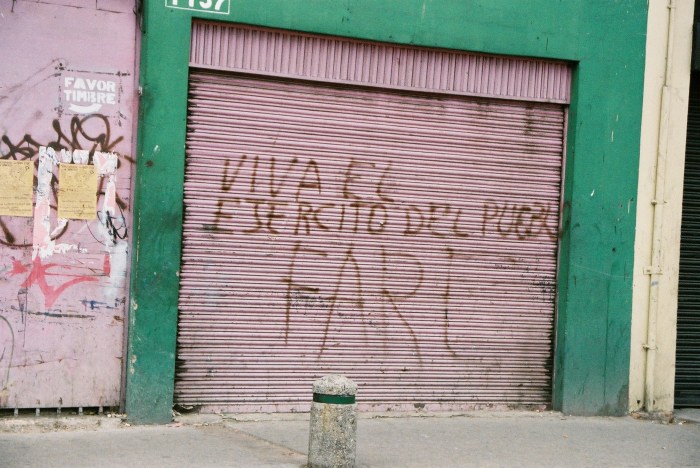
Graffiti in Colombia reads 'Viva el ejercito del pueblo FARC' i.e. 'Long live the army of the people, FARC'

Colombia must finally reckon with the religious element of its decades long internal conflict

Darkness falls quickly in Colombia due to its proximity to the equator, and it was no different on the night of Thursday 5 July 2007. As night closed in, Joel Cruz Garcia, a 27-year-old pastor, heard banging on the front door of the small home he shared with his wife Yuvy and their nine-month-old daughter in the village of El Dorado in the department of Huila. When the pastor opened the door, he was faced with a heavily armed group of individuals dressed in the uniform of the 17th Brigade of the Revolutionary Armed Forces of Colombia, better known as the FARC, who demanded that he come with them.  

The pastor was given no choice, and his wife later recounted how even as the guerrillas manhandled him and ridiculed his faith, Joel quoted a Bible verse to them, saying, ‘To live is Christ and to die is gain.’ 

‘Good,’ the guerrillas responded. ‘Then you will die.’ 

Continue reading “Colombia must finally reckon with the religious element of its decades long internal conflict”
World NGO Day: Standing up for those who stand up for others

27 February marks World NGO Day – a day to celebrate the work of non-governmental organisations (NGOs) around the world. As a key part of civil society, NGOs help to drive positive change, protecting and promoting fundamental human rights, democracy, and rule of law.

CSW networks and collaborates with hundreds of NGOs around the world, empowering communities whose concerns may often be overlooked, amplifying these issues in international advocacy arenas, and whenever possible, providing a platform for them to address policy makers directly.

Even as the world celebrates the invaluable work of civil society, there are many countries, including several on which CSW focuses, where the work of NGOs is not celebrated, but is instead stifled or shut down by state or non-state actors.

India: Civil society suffocated

Perhaps one of the most restrictive environments for NGOs to operate in is in India. In recent years, the country’s ruling Bharatiya Janata Party (BJP) and other Hindu nationalist groups have increasingly attempted to label dissent as damaging to India’s national interests, arguing that those who speak up about human rights are ‘anti-nationals.’

Continue reading “World NGO Day: Standing up for those who stand up for others”

Colombia: Planting seeds of hope amid conflict and COVID-19

30 November marked the fourth anniversary of the approval of a peace agreement between the Colombian government and the Revolutionary Armed Forces of Colombia (the FARC-EP) by the Colombian Congress. Four years later the country still has a long way to go, as violence continues in several departments and those working in peacebuilding find themselves increasingly targeted by armed actors. Add to this the effects of the COVID-19 pandemic and the picture is one of serious concern.

CSW spoke to Pablo Moreno, Rector of the Unibautista Baptist Seminary in Cali and Director of the Colombian Council of Evangelical Churches Peace Commission (CEDECOL).

“The COVID-19 pandemic has affected Colombia much like the rest of the world. There have been months of upheaval in the worlds of academia, work and religion. Periods of lockdown have shifted many areas of human life into the virtual realm, altering the physical meetings and face-to-face encounters we had become accustomed to.

In the midst of this, violence has increased in Colombia. Illegal armed groups occupying territories abandoned by the FARC-EP are fighting among themselves for control over drug trafficking routes. At the same time these groups are used to frighten the population to make them leave their homes so that they can build illegal mines, expropriate land, and expand their social dominance in a way that benefits them.

Continue reading “Colombia: Planting seeds of hope amid conflict and COVID-19”

FoRB on the Frontlines: “We left the city and did not return”

In several Latin American countries, religious leaders often take on the roles of community leader and human rights defender. As a result, these leaders often face harassment, intimidation and even violence at the hands of state and non-state actors. Over the next few weeks CSW will be presenting interviews with religious leaders working in the region to highlight their experiences on the frontlines of freedom of religion or belief.

Otto is a Protestant pastor working in Tuluá, Colombia.

“If you say anything you will end up like those two…

It was a Sunday morning, everything was normal, but it was a day in which our lives would change.

Continue reading “FoRB on the Frontlines: “We left the city and did not return””

The cost of backtracking: delays in Colombia’s peace process risk a return to violence

In November 2016 a revised peace agreement was signed between the government of Colombia and the Revolutionary Armed Forces of Colombia–Army of the People (FARC-EP). The deal was considered a big win by many, bringing an end to a conflict which spanned over five decades and claimed hundreds of thousands of lives.

This celebration has been considered both “justified and premature.” In the following years parts of Colombia have enjoyed a somewhat fragile peace, but recent developments have raised concerns that this peace could shatter altogether.

Government foot-dragging

Particularly concerning is the current government’s approach to the 2016 agreement. Since his election in June 2018, the President Iván Duque Márquez-led administration has consistently slowed down the process of implementation.

Continue reading “The cost of backtracking: delays in Colombia’s peace process risk a return to violence”