The cost of backtracking: delays in Colombia’s peace process risk a return to violence

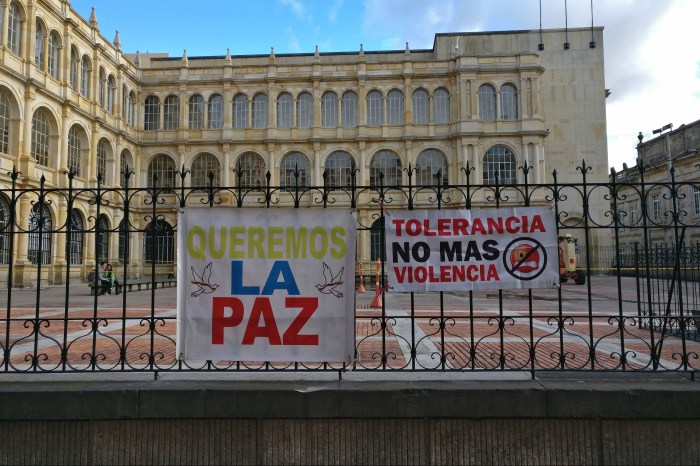
In November 2016 a revised peace agreement was signed between the government of Colombia and the Revolutionary Armed Forces of Colombia–Army of the People (FARC-EP). The deal was considered a big win by many, bringing an end to a conflict which spanned over five decades and claimed hundreds of thousands of lives.

This celebration has been considered both “justified and premature.” In the following years parts of Colombia have enjoyed a somewhat fragile peace, but recent developments have raised concerns that this peace could shatter altogether.

Government foot-dragging

Particularly concerning is the current government’s approach to the 2016 agreement. Since his election in June 2018, the President Iván Duque Márquez-led administration has consistently slowed down the process of implementation.

Continue reading “The cost of backtracking: delays in Colombia’s peace process risk a return to violence”

Mexico’s Culture of Impunity Part 2: Lost years and missed opportunities

Last week, CSW’s Latin America Advocacy Officer detailed the culture of impunity that hinders the protection and promotion of freedom of religion or belief (FoRB) in Mexico. In this post we put a human face on the effects of the government’s inadequate response to violations of FoRB, showing what happens to individuals when authorities delay or neglect their responsibilities to protect religious minorities.

Click here to read this post in Spanish.

One case which illustrates the deep rooted culture of impunity that surrounds attacks on religious minorities in Mexico is that of the community of Yashtinin in San Cristóbal de las Casas Municipality in Chiapas State.

Everything began in 2012, when several people converted away from the majority religion. Some members of the community were afraid that this new religion would damage their customs and traditions and negatively affect their children. On 10 June 2012 a large group from the community went to the house of a Santiago Hernández Vázquez, one of the men who had converted, and took everyone that was meeting there to prison, insulting them and threatening them with violence and even death in the process.

After imprisoning 16 men and boys in a space normally meant to hold a single individual, local teachers employed by the government falsified a document stating that the families had voluntarily decided to leave the community. The victims were forced to sign it and given three days to leave. Upon the expiration of the ultimatum, 12 families were expelled after villagers destroyed all of their homes and property. By 2015, a total of 28 families had been expelled.

Continue reading “Mexico’s Culture of Impunity Part 2: Lost years and missed opportunities”

Mexico’s Culture of Impunity Part 1: Mediation in lieu of justice

While Mexico’s drug trade is far from vanished, President Andrés Manuel López Obrador (AMLO) recently stated that “there is no longer a war.” He has a new strategy. The president says they are no longer trying to arrest drug lords, but instead want to look at the causes of violence.

“We have not detained the bosses [of criminal gangs] because this is not our main function. The government’s main function is to guarantee public security…What is important to me is lowering the number of homicides, robberies, that there are no kidnappings. This is what is essential! Not the spectacular, because we lost a lot of time in this and it resolved nothing.”

To achieve this, AMLO appears to be looking to religious groups.

Continue reading “Mexico’s Culture of Impunity Part 1: Mediation in lieu of justice”

Venezuela: “If we, as Christians who yearn to live in justice, look at the reality of our nation, we cannot remain silent.”

A young church leader is unwittingly caught up in a security dragnet, arrested, falsely accused and imprisoned. Another church youth leader is shot and killed when security forces open fire on peaceful protestors. In the same country, the military surrounds a cathedral where over a thousand peaceful protestors have sought refuge after fleeing tear gas and violence at the hands of security forces.

What is happening in Venezuela today shows how religious groups can become caught up in larger political movements, sometimes despite their best efforts to remain neutral and disengaged from politics.

Once religious groups find themselves in situations like these they can be forced out of their neutrality, putting them in opposition to powerful forces; this in turn can lead to violations of freedom of religion or belief (FoRB) as the authorities crack down on what they perceive to be rebellious religious groups.

Continue reading “Venezuela: “If we, as Christians who yearn to live in justice, look at the reality of our nation, we cannot remain silent.””

FoRB on the Frontlines: Fighting for freedom as long as it’s necessary

The Ladies in White are a Cuban peaceful protest movement comprising the wives and other female relatives of jailed dissidents. Last year CSW interviewed their leader, Berta Soler, about her experiences, and the challenges facing Cuba:

“My activism really got started in 2003 when the government took [imprisoned] 75 men and one woman just because they defended the Declaration of Human Rights.

I and the other Ladies in White are women who are prepared, very well prepared, and aware that we are in a struggle for the freedom of political prisoners and for respect for human rights in my country. And we, the Ladies in White and I, are very conscious that in my country we need freedom and rights, especially for the men and women who are in prison just for demanding this and promoting and defending the Universal Declaration of Human Rights.

Continue reading “FoRB on the Frontlines: Fighting for freedom as long as it’s necessary”