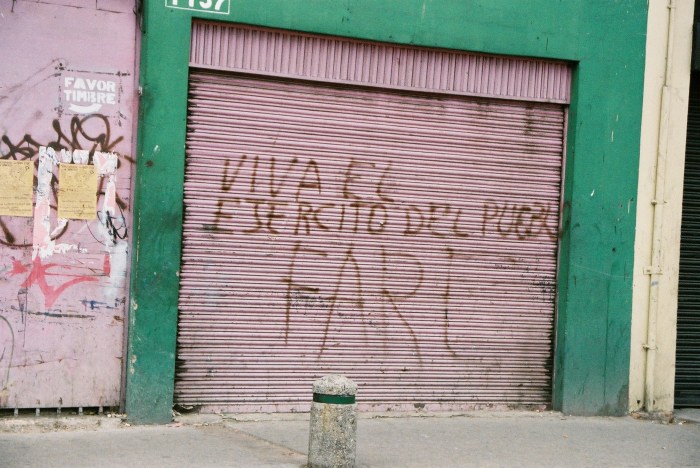
Graffiti in Colombia reads 'Viva el ejercito del pueblo FARC' i.e. 'Long live the army of the people, FARC'

Colombia debe finalmente enfrentarse al elemento religioso de su conflicto interno que lleva décadas

En Colombia la oscuridad llega rápidamente debido a su proximidad al ecuador, y no fue diferente el jueves 5 de julio de 2007.  Esa noche, Joel Cruz García, un pastor de 27 años, escuchó golpes en la puerta principal de la pequeña casa que compartía con su esposa Yuvy y su hija de nueve meses, en el pueblo de El Dorado en el departamento de Huila. Cuando el pastor abrió la puerta, se encontró con un grupo de individuos fuertemente armados y vestidos con el uniforme de la Brigada 17 de las Fuerzas Armadas Revolucionarias de Colombia, mejor conocidas como las FARC, quienes le exigieron que los acompañara.

Al pastor no se le dio otra opción, y su esposa contó más tarde cómo, incluso cuando los guerrilleros lo maltrataban y le ridiculizaban por su fe, Joel les citó un versículo de la Biblia que decía: “Vivir es Cristo y morir es ganancia”.

“Bien”, respondieron los guerrilleros. “Entonces morirás”.

Continue reading “Colombia debe finalmente enfrentarse al elemento religioso de su conflicto interno que lleva décadas”
A street with flags flying in Michoacán, Mexico.

Religious minorities in Michoacán, Mexico just wanted to be treated equally

Michoacán is a state located in central Mexico. This region of mountains and forests is inhabited by the P’urhépecha indigenous populations, whose language P’urhe is still spoken today and who are renowned for their fine work with the different types of wood found in the area. The P’urhépecha are concentrated in 22 municipalities across the breadth of the state.

Michoacán is also known for its natural beauty and the richness of its land and climate, making it a favourable place for the cultivation of different fruits exported internationally, including the avocado. Mexico is the largest producer worldwide of this precious product which has an annual economic impact of billions of dollars.

The P’urhépecha Plateau is home to around 70% of Mexico’s national avocado production. This has given rise to clashes in Michoacán between organized crime groups as they vie for control of the territory and avocado market. The situation has led, in turn, to the formation of community militias and self-defence groups who, fed up with the extortion and the abuses committed by the organized crime groups, have taken up arms to protect their lands. In some cases, however, these community militias and self-defence groups have also been involved in the violation of human rights.

Continue reading “Religious minorities in Michoacán, Mexico just wanted to be treated equally”
A street with flags flying in Michoacán, Mexico.

México: Las minorías religiosas en Michoacán solo desean ser tratadas con igualdad y respeto

Michoacán es un estado ubicado en el centro de México. Esta región de montañas y bosques está habitada por las poblaciones indígenas P’urhépecha, cuya lengua P’urhe aún se habla hoy en día y que son reconocidos por su fino trabajo y artesanías con los diferentes tipos de madera que se encuentran en la zona. Los p’urhépecha se concentran en 22 municipios a lo largo del estado. 1

Michoacán también es conocido por su belleza natural y la riqueza de su tierra y clima, lo que lo convierte en un lugar propicio para el cultivo de diferentes frutas que se exportan a nivel internacional, entre ellas el aguacate. México es el mayor productor a nivel mundial de este preciado producto que tiene un impacto económico anual de miles de millones de dólares.

La meseta de P’urhépecha alberga alrededor del 70% de la producción nacional de aguacate de México. Esto ha dado lugar a enfrentamientos en Michoacán entre grupos del crimen organizado que se disputan el control del territorio y el mercado del aguacate. La situación ha provocado, a su vez, la formación de milicias comunitarias y grupos de autodefensa que, hartos de la extorsión y los abusos cometidos por los grupos del crimen organizado, han tomado las armas para proteger sus tierras. En algunos casos, sin embargo, estas milicias comunitarias y grupos de autodefensa también han estado involucrados en la violación de los derechos humanos.

Continue reading “México: Las minorías religiosas en Michoacán solo desean ser tratadas con igualdad y respeto”
Fang Bin with his wife and son in an undated photo.

A family shattered for 24 years – the story of Falun Gong activist Fang Bin

Crowded hospital halls, frantic doctors and nurses in protective suits, patients lying in the corridors, body bags piled up in a funeral van outside a hospital… In early February 2020, 57-year-old businessman Fang Bin drove around Wuhan and documented what he saw in five hospitals. The short videos he posted on social media gave a rare glimpse into what was happening in the epicentre of the pandemic under lockdown.

Mr Fang was detained by police briefly on 1 February 2020. In the next few days, he became more outspoken. Videos were widely shared on social media in which he commented that ‘tyranny lies at the root of this virus’. Then, on 9 February 2020, he vanished after calling ‘all citizens to resist’ tyranny and the government to ‘return the power to the people’ on YouTube, a platform banned in China.

The disappearances of Fang Bin, Zhang Zhan and at least two other citizen journalists drew the attention of world media. Although Mr Fang and his wife are known to the authorities as veteran Falun Gong activists, people who are familiar with him hesitated in mentioning his faith background when calling for his release. They may have been conscious of the social stigma attached to this belief group in China, or feared that he might be jailed not for his online speech but for his faith, or even that he might face mistreatment for it in police custody.

Continue reading “A family shattered for 24 years – the story of Falun Gong activist Fang Bin”
Fang Bin with his wife and son in an undated photo.

一个破碎了24年的家庭——法轮功维权人士方斌的故事

拥挤的医院大厅、奔忙的穿戴全身防护的医护人员、躺在走廊里的病人、堆放在医院外殡葬车上的尸袋……2020 年 2 月初,57 岁的商人方斌驾车在武汉市内转悠,记录下了他在五家医院的所见所闻。他在社交媒体上发布的短视频让人们难得一见地看到疫情中心地带发生的一切。

2020 年 2 月 1 日,方斌被警方短暂拘留。获释后,他变得更加敢言。在社交媒体上广泛传播的视频中,他直言不讳地说:“病毒的根源是暴政!” 几天后,2 月 9 日,他在 YouTube(一个在中国被禁止的社交媒体平台)上呼吁“全民反抗”、要求当局“还政于民”后消失。

方斌、张展和另外至少两名公民记者的先后失踪引起了全世界媒体的关注。尽管当局知道方斌及其妻子是资深法轮功维权人士,但很多熟悉的朋友在呼吁释放方斌时,选择不提他的信仰背景。他们可能意识到中国社会仍对法轮功这一信仰团体存在某种歧视,或者担心当局对方斌抓捕判刑可能不基于其网络言论而基于其信仰,他甚至可能因之遭到当局酷刑。

Continue reading “一个破碎了24年的家庭——法轮功维权人士方斌的故事”