Justice Delayed is Justice Denied

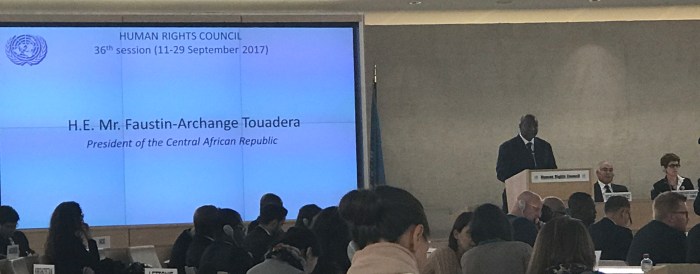
Next week the United Nations’ (UN) Human Rights Council (HRC) is holding a high level dialogue to assess the situation in the Central African Republic (CAR). The last time the HRC considered the situation of CAR was in September 2017, when President Faustin-Archange Touadéra made an unexpected appearance, and addressed member states, nongovernmental organisations (NGOs) and human rights mandate holders.

Christian Solidarity Worldwide (CSW) was present during this address and noted the positive engagement CAR maintains with the UN’s human rights mechanisms, including by granting access to the Independent Expert on CAR, Ms. Marie-Therese Keita Bocoum.

End of transition was not the end of the security crisis

During his speech, President Touadéra noted that the end of the transitional government and the return to democracy did not bring an end to the security crisis in CAR. Since November 2016, armed groups that were once part of the Seleka Alliance have clashed in the north and eastern regions. This violence has been characterised by the targeting of civilians and destruction of civilian infrastructure leading to mass displacement.

Continue reading “Justice Delayed is Justice Denied”
UK General Election: an opportunity to reiterate a commitment to human rights

Coming less than a year after the EU referendum, the UK’s snap General Election on Thursday will provide a fresh opportunity to ensure human rights are at the heart of government policies.

Amid competing priorities, it remains important that the new government pledges to uphold the UK’s commitment to human rights, including the right to freedom of religion or belief (FoRB) in all aspects of foreign policy, including diplomacy, international aid and trade.

Freedom of Religion or Belief matters

According to the United States Commission for International Religious Freedom (USCIRF), the state of international religious freedom is worsening in both the depth and breadth of violations. Its new report states:

“the blatant assaults have become so frightening—attempted genocide, the slaughter of innocents, and wholesale destruction of places of worship—that less egregious abuses go unnoticed or at least unappreciated.”

Against this backdrop, it’s increasingly important that the government shows its commitment to protecting this right. It must speak with boldness in challenging FoRB violations and allocate adequate resources, in addition to using its diplomatic and political capital, to address them.

Continue reading “UK General Election: an opportunity to reiterate a commitment to human rights”

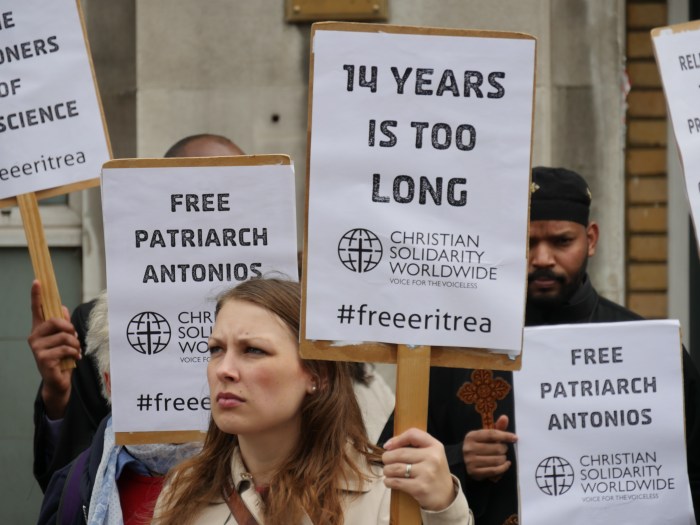
Eritrea Protest Vigil 2017

Three years ago, I found myself at the United Nations Human Rights Council (HRC), playing a game with an eight year old girl – I would say the name of an animal and she would draw it.  She was an Eritrean refugee and had come to the HRC with her parents as part of a delegation who were there to give testimony at a side event. Her entire family had been detained by the government, locked up with others in a shipping container. She shared memories of the entire place smelling awful, of being freezing cold at night and roasting hot during the day and of how she and her other siblings joked about which family member was covered with the most lice. A serious issue was turned into a game as their parents did  their best to shield their children from the full force of the horrors they were experiencing.

Continue reading “Eritrea Protest Vigil 2017”

India: Striving for Hindu rashtra at the expense of democracy

Recognise that restrictions on public freedoms, extreme inequalities and the mainstreaming of hate around the world are “shearing off the protections that maintain respect”, the High Commissioner for Human Rights, Zeid Ra’ad Al Hussein pleaded with Member States at the 32nd session of the Human Rights Council (HRC).

This sentiment is usually associated with states experiencing severe human rights violations, but the remark is equally relevant to states where human rights violations take place but appear less visible and fail to make news headlines.

The world’s largest democracy

The words ‘largest democracy’ are synonymous with India as a nation state with an electorate of 1.25 billion people and growing. The choice of the Bharatiya Janata Party (BJP) to lead the country may have come as a result of Modi’s election promises of a market orthodoxy for economic revival and open trade.

As such, any proposition that religious freedom in India is deteriorating is deflected by the ‘democracy’ rhetoric despite research showing that understanding freedom of religion or belief is good for business; it comes as no surprise that this defence is readily used by those who have trade and business interests in India, thus casting a cloak of invisibility about the violence against minorities based on religious grounds.

Continue reading “India: Striving for Hindu rashtra at the expense of democracy”

Can the UN be true to its democratic principles without reforming the NGO Committee?

3_un-flag

Broad participation and representation, including vibrant civil society participation, are essential prerequisites for democratic development. However, as the United Nations (UN) marks the International Day of Democracy today, it is clear that the UN system faces severe internal challenges on this front.

Importance of ECOSOC NGO Committee

The access a number of NGOs have to the UN has been continuously blocked by the The Economic and Social Council (ECOSOC) Committee on NGOs through arbitrary deferrals and denial of ECOSOC consultative status.

Continue reading “Can the UN be true to its democratic principles without reforming the NGO Committee?”