No Ifs, No Buts: Torture Should Be Universally Condemned

“He was forced to take medicine. They stuffed the pills into his mouth… After taking the pills he felt pain in his muscles and his vision was blurred… He was beaten. He endured gruelling questioning while being denied sleep for days on end…” 

Wang Qiaoling describing the torture of her husband, lawyer Li Heping

“Even our breaths were suppressed. No voices. No texts. No images. No talking. No walking. Our hands, feet, our posture…every body movement was strictly limited. We needed permission for even the most trivial action”.

 Lawyer Zhao Wei, the youngest legal assistant detained in the 709 Crackdown

“Prisoners were also put in cages submerged mostly in water, and left inside for seven days, the entire body underwater with a space to breath at the top. As they stood in the water and tried to sleep, rats would scurry about outside the cage, biting their nose and ears.” 

Letter to world leaders by ‘709’ Family Members

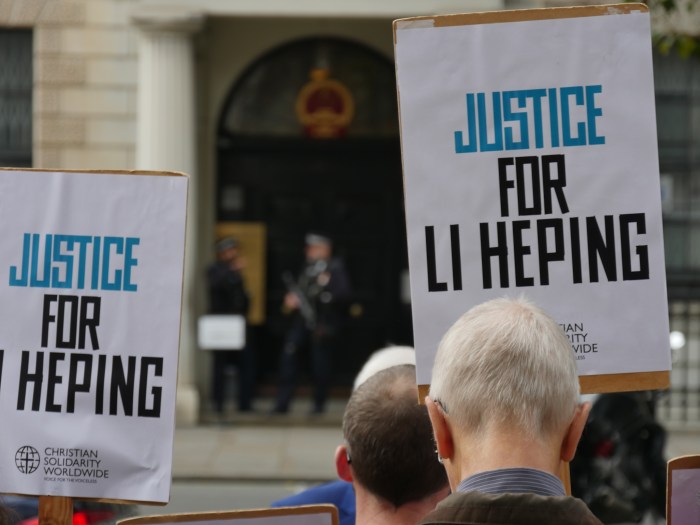
These are just a few accounts of the torture experienced by human rights lawyers in China. Over 300 lawyers, activists, colleagues and family members were detained, interrogated or disappeared in a sweeping crackdown beginning on 9 July 2015, dubbed the 709 Crackdown. Two years on, most have been released, some on “bail” conditions amounting to house arrest, but with news of their release have come numerous testimonies of physical and psychological torture including frequent beatings, sleep deprivation, forced medication, violent threats, and prolonged isolation.

Use of torture in China

Lawyers and activists are by no means the only victims of torture. Many of the lawyers caught up in the crackdown had defended clients who had been tortured by police or security agents, including those arrested in connection with their religion or belief such as Falun Gong practitioners and Christians associated with unregistered churches, as well as those accused of crimes not related to politics or religion.

Li Heping reunion
Human rights lawyer, Li Heping (right) pictured with his brother Li Chunfu (left) following his release from detention.
Continue reading “No Ifs, No Buts: Torture Should Be Universally Condemned”

Li Heping’s Release – A Moment to Celebrate or a Continuing Case of Concern?

Li Heping’s reunion with his family on 9 May 2017 was a moment for celebration; the celebration of an innocent man’s reunion with his long-suffering family and the celebration of the end of a period of torture, interrogation and imprisonment. But the joy of Li Heping’s reunion with his family is tempered by continuing concerns for his safety, and the injustice of his situation.

Who is Li Heping?

Li Heping is one of China’s most experienced and high profile human rights lawyers. He began working on sensitive cases around 2002 and is well known for defending the human rights of religious minorities, including Christians and Falun Gong practitioners, as well as activists and victims of torture.

His work on these cases led to a confrontation with the state. A Chinese security agent reportedly once told him that, in the eyes of Beijing, Li had become “more dangerous than Bin Laden”. In September 2007, Li was abducted, stripped and tortured by security forces. He then had his lawyers’ license revoked in 2009, and continued to be consistently monitored.

Continue reading “Li Heping’s Release – A Moment to Celebrate or a Continuing Case of Concern?”

Latent Justice: The Unfinished Gujarat Story

“The Gujarat Carnage 2002, is certainly one of the bloodiest chapters of post-independent India. The painful reality is, that those responsible for it, are now at the helm of power in India” – Father Cedric Prakash (Human Rights Activist)

Confronting past crimes is unsettling, particularly when the perpetrators continue to enjoy political immunity. Fifteen years ago on 28 February 2002, violence in Gujarat, India covered the news headlines as an estimated 2,000 Muslims were massacred over several months across 16 districts in the country.

Continue reading “Latent Justice: The Unfinished Gujarat Story”

Bangladesh: How long will impunity rule?

“The culture of impunity can’t go on or violence will increase.” – Ajoy Roy

The words of Ajoy Roy, the frail father of the late Avijit Roy hit us hard. We listened in silence as he shared his despair and disappointment at the lack of judicial process following the murder of his son in 2015. The murder of Avijit Roy, a blogger, made international news and became a case representative of the situation facing not just bloggers but journalists, lawyers, religious leaders and religious minorities in Bangladesh; these members of Bangladesh’s civil society are vulnerable to threats, harassment and attacks.

Continue reading “Bangladesh: How long will impunity rule?”

Ahok’s Case: Indonesia’s Pluralism is still in Peril

UPDATE: In May 2017, Ahok was sentenced to two years imprisonment on blasphemy charges. Click here to read more. 

UPDATE 2: Ahok was released in January 2019.

Three years ago today, Christian Solidarity Worldwide (CSW) published one of its most important reports in recent times: Indonesia: Pluralism in Peril – The rise of religious intolerance across the archipelago. The report accomplished three things: it illustrated that religious intolerance in Indonesia is now a nationwide phenomenon, contrary to popular myth, and is not confined to particular parts of the archipelago; it demonstrated that it affects everyone, of all religions – Christian churches are closed down or attacked, Ahmadiyya Muslim mosques and homes burned, Shi’as displaced, Buddhist temples targeted and Confucianists vulnerable, as well as pluralistic-minded Sunnis, and atheists; and it proved that the last President of Indonesia, Susilo Bambang Yudhoyono, was responsible for giving the radical Islamists the green light and fuelling the erosion in the values of the ‘Pancasila’, Indonesia’s state philosophy that protects freedom of religion or belief (FoRB) for all six recognised religions.

Three years on, what has changed?

Continue reading “Ahok’s Case: Indonesia’s Pluralism is still in Peril”