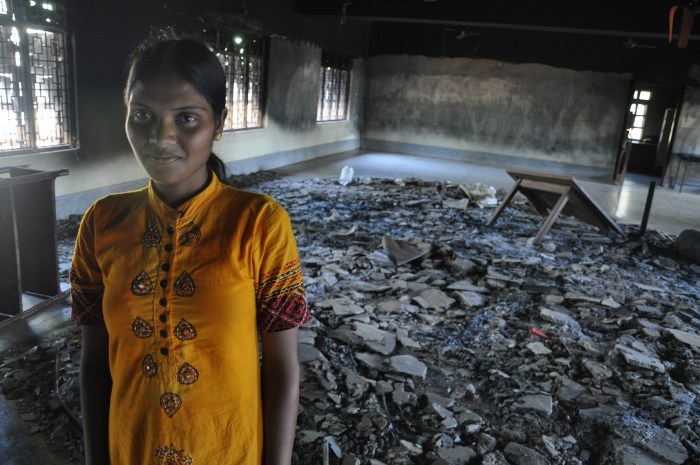
Extremists Emboldened As Religious Intolerance Rises in India’s Tamil Nadu state.

It has been two months since Persia Jacob was repeatedly kicked in the face when she resisted a mob of Hindu extremists who tried to snatch her Bible away from her. She wakes up with a heavy head every morning, having to take medication to relieve her of the trauma, even if temporarily, so that she can get on with her day.

The 38 year-old Christian remained persistent that she would die and couldn’t be without the Bible as they pushed and slapped her, stripping off her saree as they tried to grab it [the copy of Bible] from her. The Bible was then set ablaze along with several other copies of Christian literature.

As well as attempting to force her to convert to Hinduism, the mob of men raided four other prayer halls in Madurai District of Tamil Nadu state, as Christians gathered for Sunday worship.

Continue reading “Extremists Emboldened As Religious Intolerance Rises in India’s Tamil Nadu state.”

Video Footage Shows Stark Reality of Physical attacks on India’s Religious Minorities

Recent years have seen a worrying, increase in attacks against religious minorities in India. Even as the country marks the 68th anniversary of the constitution, which guarantees the freedom to profess, practice and propagate religion, there is evidence that there has been a dramatic rise in tensions between religious groups, due in large part to the validation of Hindu nationalism propagated by the ruling Bharatiya Janata Party (BJP) party, guided by the Rashtriya Swayamsevak Sangh  (RSS), its ideological wing.

Recent video footage obtained by CSW of a physical attack against two Christians portrays the stark reality for many religious minorities in India today.

VIDEO: Two church leaders from Full Gospel Pentecostal Church in Kadamalaikuntu, Tamil Nadu are seen here being threatened, ridiculed and forcefully detained by six men on motorbikes as they attempted to leave a village after distributing Christian tracts. They also had sacred ash forcefully applied on them.

Continue reading “Video Footage Shows Stark Reality of Physical attacks on India’s Religious Minorities”

Warning Signs Unheeded: The Kandhamal Tragedy

Kandhamal district is among the poorest and most marginalised in Odisha (formerly Orissa) state, India. On 25 August 2008, it was the epi-centre of communal attacks against the Christian community in India. Local monitoring groups have estimated that over 90 people were killed with at least 54,000 displaced and over 300 churches destroyed by groups belonging to the Rashtriya Swayamsevak Sangh (RSS) that espouses the Hindutva ideology.

Ten years on, attacks on religious minorities and on freedom of expression by groups belonging to the RSS continue. The lack of official condemnation towards acts of intimidation and violence has further empowered these groups. As with recent attacks against religious minorities in India, the carnage that unfolded in Kandhamal was not a one-off isolated incident devoid of a historical narrative.

Continue reading “Warning Signs Unheeded: The Kandhamal Tragedy”

Justice Delayed is Justice Denied

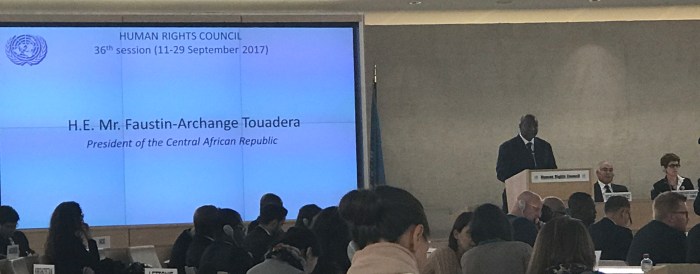
Next week the United Nations’ (UN) Human Rights Council (HRC) is holding a high level dialogue to assess the situation in the Central African Republic (CAR). The last time the HRC considered the situation of CAR was in September 2017, when President Faustin-Archange Touadéra made an unexpected appearance, and addressed member states, nongovernmental organisations (NGOs) and human rights mandate holders.

Christian Solidarity Worldwide (CSW) was present during this address and noted the positive engagement CAR maintains with the UN’s human rights mechanisms, including by granting access to the Independent Expert on CAR, Ms. Marie-Therese Keita Bocoum.

End of transition was not the end of the security crisis

During his speech, President Touadéra noted that the end of the transitional government and the return to democracy did not bring an end to the security crisis in CAR. Since November 2016, armed groups that were once part of the Seleka Alliance have clashed in the north and eastern regions. This violence has been characterised by the targeting of civilians and destruction of civilian infrastructure leading to mass displacement.

Continue reading “Justice Delayed is Justice Denied”

Shared experiences in the context of extreme violence: what is the Church’s role?

Over the past decades, both Peru and Colombia have experienced internal conflicts which involved extreme levels of violence in many regions and high loss of life. While the conflicts were political (pitting far left groups against the government and/or far right paramilitary groups) they directly impacted ordinary civilians and civil society, including churches.

In many cases, Christians, especially church leaders, were targeted for different reasons by the various armed actors. This directly affected freedom of religion or belief (FoRB) in those areas.

In both countries, the larger Church (composed of many different denominations) found itself looking for ways to respond to the conflict and especially how to support the churches, Christians and others living in conflict zones.

Continue reading “Shared experiences in the context of extreme violence: what is the Church’s role?”