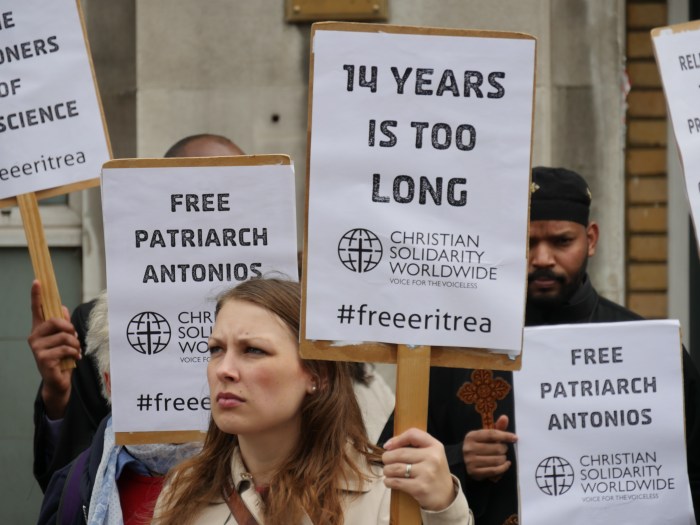
Eritrea Protest Vigil 2017

Three years ago, I found myself at the United Nations Human Rights Council (HRC), playing a game with an eight year old girl – I would say the name of an animal and she would draw it.  She was an Eritrean refugee and had come to the HRC with her parents as part of a delegation who were there to give testimony at a side event. Her entire family had been detained by the government, locked up with others in a shipping container. She shared memories of the entire place smelling awful, of being freezing cold at night and roasting hot during the day and of how she and her other siblings joked about which family member was covered with the most lice. A serious issue was turned into a game as their parents did  their best to shield their children from the full force of the horrors they were experiencing.

Continue reading “Eritrea Protest Vigil 2017”
Shifting Alliances in Northwest Syria Make a Political Solution More Remote

In northwest Syria, religious minorities have suffered multiple attacks on their properties, places of worship and unknown numbers have been killed. The rights of small Christian and Druze communities that remain are likely to be further restricted by the rapidly changing political and military landscape in the area.

Talks in Astana, Kazakhstan

The Kazakh capital, Astana, has been the site of several rounds of talks organised by Russia, Iran and Turkey aimed at finding a political solution to the Syrian crisis. However, shifting power play between the different armed groups that constitute the rebel movement continues to throw up hurdles in the path towards peace.

Continue reading “Shifting Alliances in Northwest Syria Make a Political Solution More Remote”

Turkey: Growing Religious Intolerance is Undermining Constitutional Commitments

American Pastor Andrew Brunson and his wife have been living in Turkey for 23 years running a church in Izmir with the full knowledge of the Turkish authorities.

However, on the 7 October 2016, they were summoned by the local police and accused for being a “threat to the national security”, with no further details supplied. While his wife was eventually released, Pastor Brunson was held in an immigration detention facility, where he was denied family visits and access to a bible. After two months in solitary confinement he was transferred to a high security prison in Izmir, before being brought before a court on 9 December, where he was informed he would be imprisoned due to his alleged links to the Gulen movement, the organisation deemed responsible for the attempted military coup in July 2016. The court did not reveal the source of this accusation. An appeal against the pastor’s imprisonment was turned down on 29 December, and a fresh appeal is expected to be launched at a higher court.

Deterioration in Human Rights and Rise in Ultra-nationalism

Pastor Brunson’s case is illustrative of the significant deterioration in human rights situation that occurred in the aftermath of the foiled military coup. Thousands of journalists, academics, activists, writers, teachers, judges and thinkers have been arrested since July 2016, accused of being “traitors and collaborators against national interests”, while others have been forced to adopt lower profiles and live in anticipation of being arrested.

Continue reading “Turkey: Growing Religious Intolerance is Undermining Constitutional Commitments”

India: Striving for Hindu rashtra at the expense of democracy

Recognise that restrictions on public freedoms, extreme inequalities and the mainstreaming of hate around the world are “shearing off the protections that maintain respect”, the High Commissioner for Human Rights, Zeid Ra’ad Al Hussein pleaded with Member States at the 32nd session of the Human Rights Council (HRC).

This sentiment is usually associated with states experiencing severe human rights violations, but the remark is equally relevant to states where human rights violations take place but appear less visible and fail to make news headlines.

The world’s largest democracy

The words ‘largest democracy’ are synonymous with India as a nation state with an electorate of 1.25 billion people and growing. The choice of the Bharatiya Janata Party (BJP) to lead the country may have come as a result of Modi’s election promises of a market orthodoxy for economic revival and open trade.

As such, any proposition that religious freedom in India is deteriorating is deflected by the ‘democracy’ rhetoric despite research showing that understanding freedom of religion or belief is good for business; it comes as no surprise that this defence is readily used by those who have trade and business interests in India, thus casting a cloak of invisibility about the violence against minorities based on religious grounds.

Continue reading “India: Striving for Hindu rashtra at the expense of democracy”

North Korea and Human Rights: A State of Denial

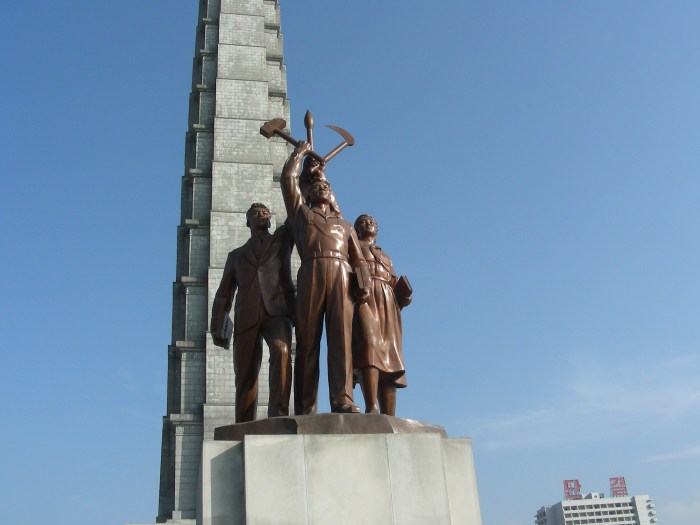
“There is almost complete denial of the right to freedom of thought conscience and religion as well as the right to freedom of opinion, expression, information and association.” That was the conclusion reached by the United Nations commission of inquiry into human rights in North Korea over two years ago. Indeed, the UN inquiry went further, noting that the regime in North Korea “considers the spread of Christianity a particularly severe threat” and as a result, “Christians are prohibited from practising their religion and are persecuted”. Severe punishments are inflicted on “people caught practising Christianity”.

Loyalty to the Regime is expected

Our new report – Total Denial: Violations of Freedom of Religion or Belief in North Koreaprovides further evidence that freedom of religion or belief is a human right that is “largely non-existent” in the country. The ruling Kim dynasty is deified. Pictures of the three generations of dictators – Kim Il Sung, Kim Jong-Il and now Kim Jong-Un – are displayed in private homes and public spaces, cleaned daily and inspected regularly by the authorities to ensure they are in the best condition. Allowing one of these photographs to decay or gather dust is akin to a blasphemy. Anything less than total loyalty to the ruling family is severely punished.

Continue reading “North Korea and Human Rights: A State of Denial”